


Johnson Arabia’s expansion across the UAE and into Saudi Arabia demonstrates how deep customer understanding and market research drives its investment decisions, including a careful curation of hybrid technology on its path toward a more sustainable future.
For over a quarter of a century, it has been one of the Gulf’s most trusted names in lifting and access solutions. Every crane, telehandler, and aerial work platform in Johnson Arabia’s fleet reflect a simple but powerful strategy: listen to customers, learn from data, and invest with purpose. This is a success story built on anticipating not chasing trends.
“We regularly evaluate new technologies and product applications that we believe can benefit our customers or introduce safer, more efficient work practices,” explains Martin Kirby, Managing Director of Johnson Arabia. “We consult with our customers before investing and monitor market demand after a product is introduced. Combining that with our ongoing account management and tracking of industry trends ensures that the products and services we launch find customers and add value.”
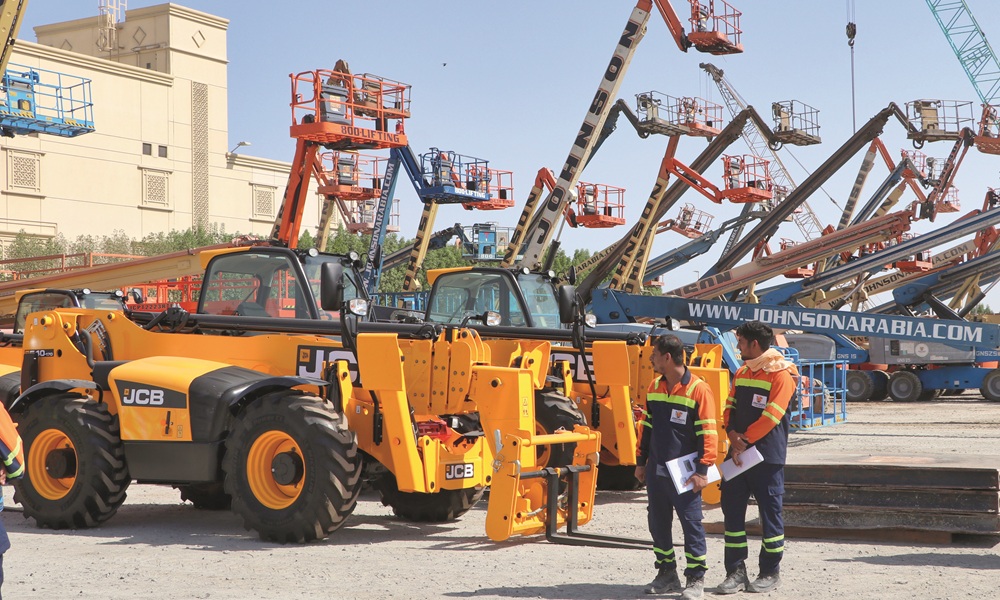
That approach has underpinned Johnson Arabia’s latest wave of fleet growth; including new cranes, spider cranes, and telehandlers in Dubai, and the introduction of hybrid scissor lifts and booms in Saudi Arabia. Together, these investments reflect both immediate demand and a clear long-term vision: to serve customers better while helping them align with the sustainability goals being advanced across the region.
This approach is built on constant information flow between its teams, customers, and the market. Rather than relying solely on macroeconomic forecasts, decisions are guided by data generated internally from its fleet and directly from the field, says Mohammad Fareed Naser, Executive Manager for UAE and Oman: “Our market insights come from both internal and external sources. Our account managers ensure we align with our customer objectives and expectations. Their information feeds not just into our forecasting but into our broader strategy. It maintains our position as a critical partner.”
To complement the local insight, Johnson Arabia also applies what Martin Kirby describes as “filters and algorithms” to global and regional market intelligence. “At a macro level,” he says, “we utilise market intelligence sources and apply various filters to identify areas where we expect investment, and to get an idea of product mix and volumes. Combining these sources with knowledge of our own fleet demand profile allows us to more accurately identify investment requirements.”
The result is a strategic investment model that responds not only to where demand is, but where it’s heading. It’s this forward-looking discipline that led to the company expanding its fleet of telehandlers and spider cranes; products that have proven especially versatile across both construction and industrial applications.
Johnson Arabia sees a shared opportunity in the UAE and Saudi Arabia, one that is shaped by similar client profiles and project demands.
“At a high level, there is not much difference between the markets,” says Joe Keely, Executive Manager of the Access Work Platform (AWP) Department. “The customer profile and projects we support are very similar, and we provide the same broad service in Saudi Arabia that we are known for in the UAE.”
That said, Keely acknowledges that some of Johnson Arabia’s most advanced solutions are still being introduced to the Kingdom. “There are some products unique to Johnson Arabia that the Saudi market has not yet experienced,” he explains. “It will take time to market and launch them, but we anticipate that within a couple of years, our customers in Saudi Arabia will also benefit from a wide range of product and service applications that they have either been unaware of or unable to source from existing rental suppliers.”
The company’s entry has been both bold and deliberate by leveraging proven strengths and introducing new concepts at the right pace. By investing in hybrid scissor lifts for its Saudi operations, for instance, Johnson Arabia is offering a new level of efficiency in the market and alignment with the Kingdom’s national vision to reduce emissions and foster sustainable construction practices.
The addition of telehandlers to Johnson Arabia’s Dubai operations, meanwhile, is another calculated move to fill what the team describes as a “capability gap” in the market.
“Demand for telehandlers has always been high,” says Mohammad Fareed Naser. “They’re a ubiquitous sight across construction sites in the UAE and Saudi Arabia. But the gap we identified was that there were no companies with the breadth of knowledge and capability of Johnson Arabia that provide this service.”
Keely elaborates that telehandlers fit naturally into the company’s existing expertise. “We have long-standing experience in operating products through our cranes division, and telehandlers fit perfectly into this wheelhouse. They offer us a first-on, last-off product that complements our other lifting and access services.”
That same logic applies to spider cranes. These are compact, agile machines that can reach difficult spaces where larger cranes cannot. “We saw a clear rise in utilisation of our Spierings and spider cranes,” Kirby says. “That’s why we expanded our fleet. More than client feedback alone, it was the data on how often and how effectively they were being used that guided the decision.”
By pairing customer consultation with utilisation analytics, Johnson Arabia ensures that every purchase has a business case rooted in real-world performance. Saudi Arabia’s ambitious giga-projects — spanning NEOM, Qiddiya, and the Red Sea developments — have created an environment where scale and adaptability are paramount. For Johnson Arabia, the key has been to enter with a strategy that combines long-term positioning with short-term responsiveness.
“We always prioritise a long-term strategic focus, which, when aligned with our forecasted market developments, can typically meet short-term customer demands,” Keely says. “We have a core fleet focus that meets most of what we expect our customers to demand, with alternative, differentiated products to support it.”
For Keely, the ability to “operate a fluid fleet” across borders enables Johnson Arabia to respond dynamically: “We can reassign fleet and operations as market demand dictates. That’s a major advantage of scale and experience.”
The Hybrid Advantage
One of Johnson Arabia’s most distinctive strengths today lies in its early and consistent commitment to hybrid and electric equipment. The company began investing in these technologies as part of a structured Environmental, Social and Governance (ESG) strategy launched in 2021, well before hybrid lifts became a regular fixture on site.
“We are the largest operator of hybrid and fully electric equipment in the region,” Martin Kirby says. “In step with regional governments, NGOs, and companies, we identified a range of UN Sustainable Development Goals that Johnson Arabia could help achieve and invested in products, services, and technologies that would enable our customers to achieve theirs.”
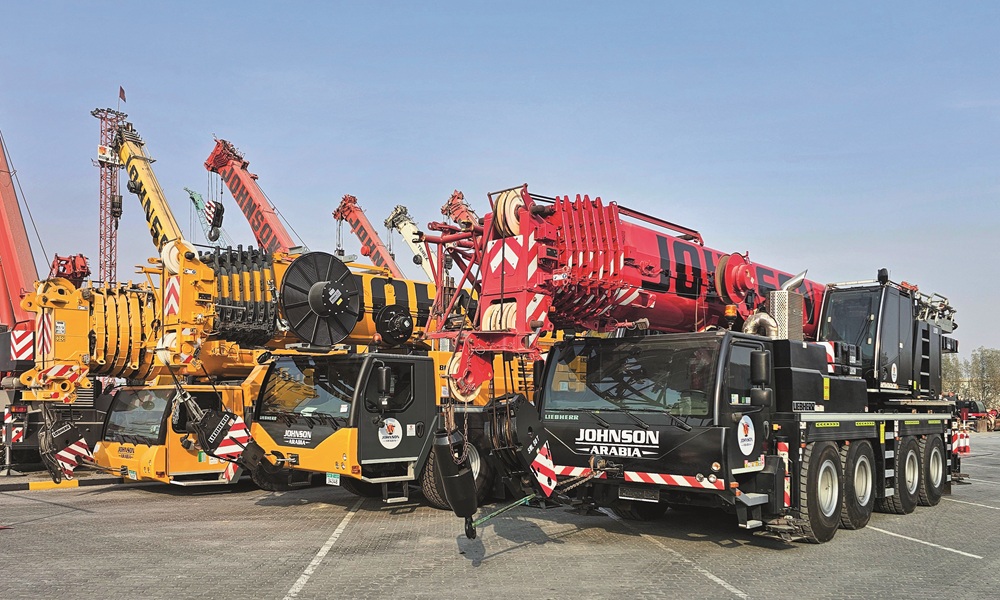
This ‘Rental Right’ strategy has been both principled and pragmatic. By offering hybrid alternatives, Johnson Arabia not only supports environmental goals but also improves operational economics for customers.
“Hybrid machines offer performance similar to, and sometimes exceeding, that of traditional diesel engines,” notes Joe Keely. “They also provide advantages in terms of running costs, as total fuel consumption is lower due to more efficient engines, supported by battery power for intensive use, reduced idling, and the option for full-electric operation.”
These dual-power units are ideal for mixed indoor–outdoor job sites. “The product can remain on site for longer,” he says. “It can progress from working outdoors on hybrid power to working indoors on electric power, reducing transport costs and site disruption.”
Johnson Arabia’s hybrid equipment is helping clients actively reduce their Scope 1 and Scope 3 emissions, a distinction that Keely highlights as increasingly important for contractors bidding on government-led projects: “In simple terms, hybrid products help reduce customer Scope 1 emissions through more efficient engine technology and solutions to minimise engine running time. They also help reduce Scope 3 emissions by being better engineered to deliver transport efficiencies and lower embodied carbon, thereby reducing the total impact of rental operations.”
While much of Johnson Arabia’s reputation in the market stems from its customer service, its influence also extends back into the supply chain. As one of the first regional adopters of hybrid and electric platforms, it is providing valuable feedback to manufacturers developing the next generation of products for the region.
Beyond the equipment, the company’s sustainability strategy also includes internal programmes centred around people, community, and workplace wellbeing; ensuring that the same principles of responsible operation extend across its entire business.
Whatever the technology being utilised on-site, speed, reliability, and accessibility remain cornerstones of the Johnson Arabia brand promise: “By consistently responding quickly to client needs, whether that means dispatching cranes on short notice, providing emergency lifting support, or adjusting schedules to meet shifting project timelines, Johnson Arabia reinforces its image as a dependable partner,” says Martin Kirby.
That responsiveness is formalised in a 24-hour hotline (052-LIFTING (052 543 8464) which provides immediate access to operational support. “It’s not just a phone line,” adds Mohammad Fareed Naser. “It’s a reflection of how closely we stay connected to our customers.”
The Road Ahead
Ultimately. Johnson Arabia’s leadership team sees a market that will continue to evolve in three key directions: sustainability, digitalisation, and customer partnership.
“Our priority will always be to continue providing customer satisfaction through our traditional lifting and access solutions,” says Martin Kirby. “As the market matures and innovates, so does Johnson Arabia. Sustainability and digitisation are becoming increasingly important as we seek to deliver more efficient, safer, and more cost-effective solutions.”
He adds that this ensures that Johnson Arabia and its customers remain competitive. “We invest in equipment that reduces our customers’ operating costs, helping them win work themselves. Our strategy remains what it has always been: to offer an industry-leading solution that allows our customers to succeed.”
And that strategy will soon take another leap forward. When asked about future fleet plans, Joe Keely concludes: “There’s a raft of investments aligned with our Rental Right philosophy that you’ll see in the coming months and years.”
