


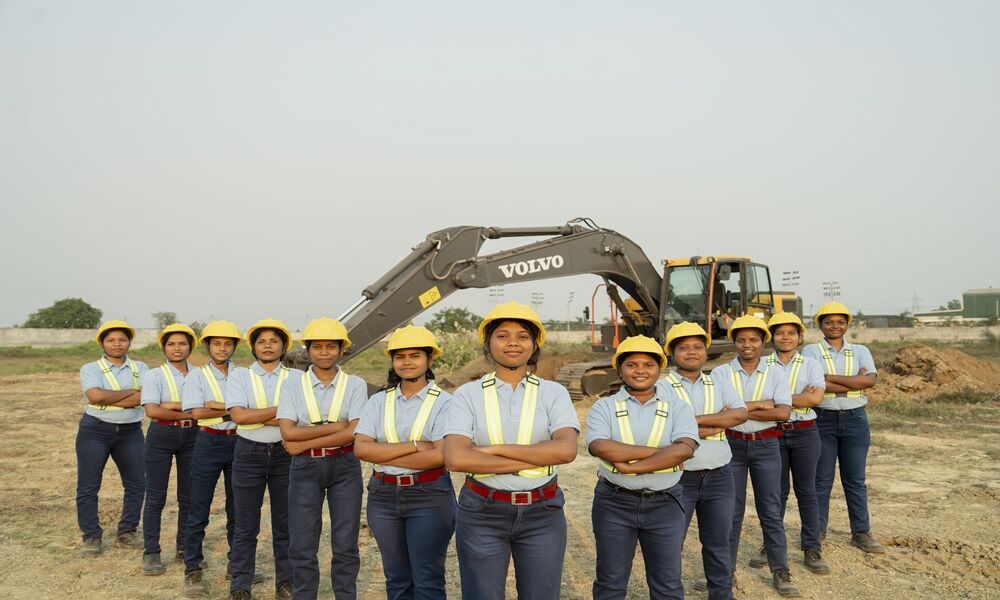
Volvo Construction Equipment (Volvo CE) has placed its Iron Women programme at the forefront of its strategy to address one of the construction industry’s most pressing challenges: a widening skills gap. By transforming the initiative into a scalable global platform, the company aims to unlock workforce potential, improve safety, and boost productivity across markets. The move signals a shift from a targeted diversity initiative to a core business solution designed to support long-term industry transformation.
As construction technologies continue to evolve rapidly, the shortage of skilled operators, technicians, and service professionals threatens to slow progress. Volvo CE’s response is to formalise Iron Women as a unified global framework that can be replicated across regions. The programme is intended to expand workforce capacity by identifying, training, and empowering talent that has historically been overlooked, particularly women.
“No skills, no scale. It’s that simple,” said Melker Jernberg, President of Volvo CE. “We can develop the most advanced machines, the smartest products and solutions, and the cleanest technology— but none of it matters if there aren’t enough skilled people to deploy it. Iron Women isn’t about diversity for diversity’s sake. It’s about competence and growth—and the entire industry grows when we unlock capacity together.”
The Iron Women concept is not new. Originally launched by Volvo Trucks in 2016, it has already enabled more than 700 women across 10 countries to enter professional driving careers. Building on this success, Volvo CE adapted the programme for the construction sector in 2024, beginning with a pilot in Ukraine. There, women were trained and certified as heavy equipment operators through collaborations with training provider ETS Group and Swedish non-profit Beredskapslyftet. The initiative forms part of a wider effort to reskill 1,000 women across industries, contributing to Ukraine’s ongoing rebuilding efforts.
Following its early success, the programme expanded to India in 2025, a key growth market experiencing an acute shortage of skilled labour. Delivered in partnership with dealer Pollutech Engineering, mining customer KCCL, and the government-backed infrastructure institute IIIC Kerala, the initiative offers three dedicated pathways: operator certification, worksite technician training, and factory floor technician development. The first group of participants achieved full job placement, moving directly into roles at customer sites and dealerships. A second cohort of 25 women has recently completed operator training and is now transitioning into employment.
“Where I come from, women are rarely encouraged to step into roles like this,” said Laxmi Naik, Participant of Iron Women India. “When I joined the program, I carried a lot of hesitation about whether I could really succeed. But over time, the training and support helped me discover my own potential. Today, I walk away not just with skills, but with confidence and the belief that I can build a different future for myself.”
With measurable success in multiple regions, Volvo CE is now scaling the Iron Women programme into a global model. By equipping more operators, technicians, and service professionals with critical skills, the initiative is expected to accelerate the adoption of new technologies, increase equipment uptime, and strengthen supply chain resilience worldwide.
“The model works,” Jernberg said. “The next step is scaling it—expanding Iron Women to build workforce capacity where it’s needed most, at a pace that matches industry transformation.”
As part of its next phase, Volvo CE plans to introduce Iron Women across additional markets in 2026, with Denmark, Norway, Sweden, and Finland currently under consideration. Through this expansion, the company aims to ensure the construction industry has the skilled workforce required to meet future demands while fostering a more inclusive and capable talent pipeline.
