


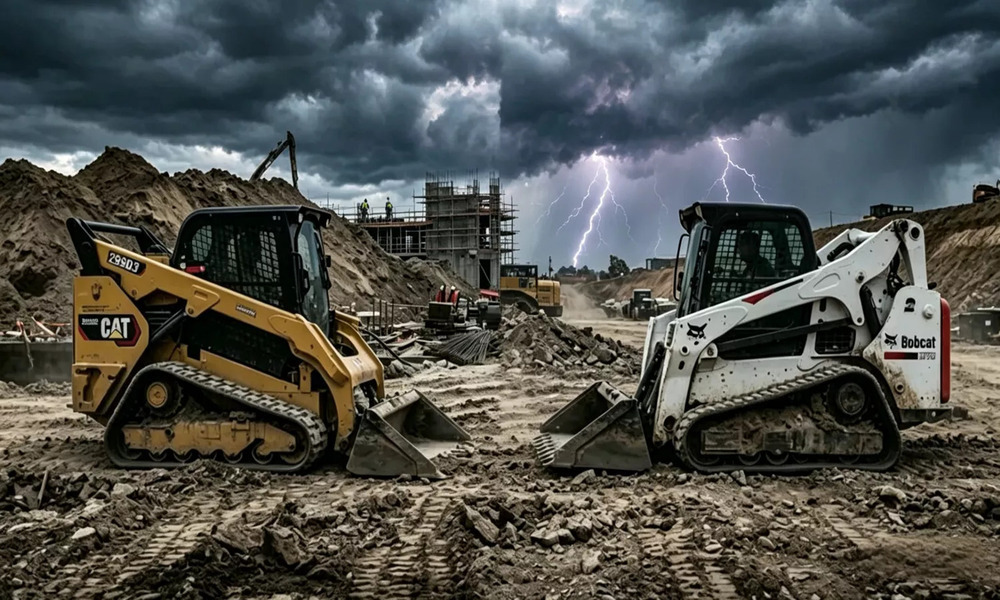
What began as a series of targeted patent complaints has now escalated into a full-scale legal confrontation between two of the most recognisable names in construction equipment. The latest move entails Caterpillar Inc. filing a counter-suit against Bobcat Company, and marks a decisive turning point in what is fast becoming one of the industry’s most consequential intellectual property battles.
At the heart of the dispute lies a deceptively simple question: who owns the technology underpinning the next generation of compact machinery?
From complaint to counterattack
The conflict was initiated by Bobcat Company, which accused its larger rival of infringing multiple patents tied to core machine technologies. These allegations span skid steer loaders, compact track loaders, excavators, and related systems, which are segments where both manufacturers compete aggressively.
Legal actions were filed not only in the United States but also across key international jurisdictions, including Europe. In some cases, the complaints reportedly extended to calls for import restrictions, signalling Bobcat’s willingness to pursue aggressive remedies that could disrupt supply chains.
Now, Caterpillar Inc. has responded in kind, and with force.
The counter-suit rejects all allegations of infringement and flips the narrative. Caterpillar claims that Bobcat itself has violated a number of its patents, while also alleging that its competitor engaged in “competitive intelligence” efforts aimed at studying, and ultimately replicating, Cat technologies.
In addition to denying wrongdoing, Caterpillar is seeking financial damages, raising the stakes from reputational defence to potential monetary consequences.
More than metal: the battle for machine intelligence
While patent disputes are not new in heavy equipment, the scale and scope of this clash are notable. More than 14 patents are reportedly involved, covering technologies that are increasingly central to modern machinery.
These include:
- Advanced hydraulic systems
- Machine control interfaces
- Automation and semi-autonomous functions
Such components represent a shift in how construction equipment is conceived and valued. No longer defined purely by mechanical robustness, today’s machines are increasingly differentiated by software, sensors, and integrated control systems.
This evolution mirrors broader industrial trends, where digital capability is becoming as critical as physical performance. For manufacturers, intellectual property in these domains is not merely defensive, it is strategic.
Global implications for manufacturers and dealers
The international footprint of the dispute adds another layer of complexity. With filings spanning multiple jurisdictions, outcomes could vary significantly across markets, potentially affecting where and how certain machines can be sold.
For dealers, this raises immediate concerns. Import restrictions or adverse rulings could limit product availability, forcing adjustments in inventory strategy or even brand alignment. In tightly contested segments such as compact equipment, where margins and differentiation are already under pressure, such disruptions could be significant.
Pricing, too, may come under strain. Should either party face licensing costs or damages, these expenses could ultimately filter through to end users. Contractors, already navigating fluctuating input costs, may find themselves indirectly exposed to the consequences of legal battles fought far upstream.
Innovation under scrutiny
Beyond commercial considerations, the dispute highlights a deeper tension within the industry: how to balance competition with innovation.
Patent protection is designed to incentivise technological advancement by granting temporary exclusivity. Yet in fast-moving sectors, overlapping development paths can lead to disputes over who arrived first, or independently.
For companies like Caterpillar and Bobcat, both with extensive R&D capabilities, the line between inspiration and infringement can be difficult to draw.
What is clear, however, is that the battleground has shifted. As machines become more digitised, the most valuable assets are increasingly intangible: embedded in code, algorithms, and system architectures rather than steel and hydraulics alone.
A defining moment for the sector
Whether this dispute is ultimately resolved through litigation, settlement, or cross-licensing agreements, its impact is likely to be lasting.
For manufacturers, it underscores the importance of robust IP strategies in an era of rapid technological convergence. For dealers and customers, it introduces a new variable into purchasing decisions: the legal status of the technologies embedded within the machines they rely on.
And for the industry as a whole, it serves as a reminder that the future of construction equipment will be shaped not only on job sites and in engineering labs, but also in courtrooms.
In that sense, this is not merely a legal skirmish. It is a contest over the rules that will govern innovation in heavy machinery for years to come.
